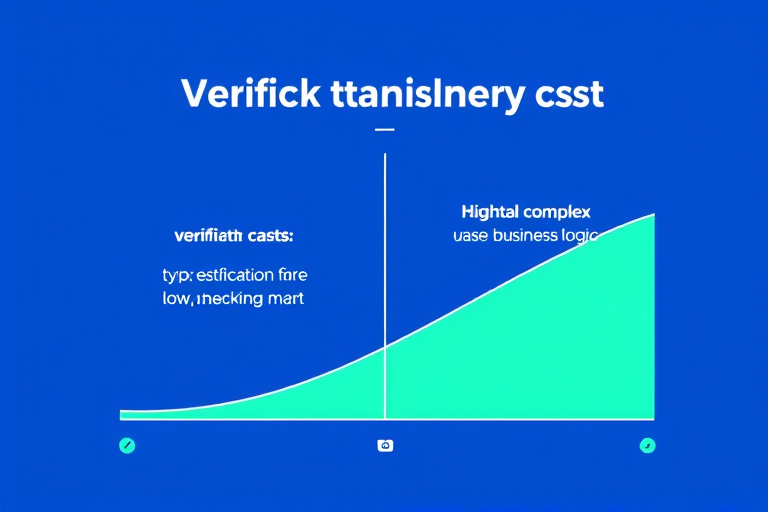
The Core Principle of AI-Assisted Development: Verification Cost Determines Applicability
In exploring AI-assisted development, I've gradually discovered a critical limitation: Natural language itself is full of ambiguity, and without repeated confirmation and interaction, the output will increasingly deviate from expectations.
The Mathematical Model of Cumulative Deviation
There's an interesting calculation: if the first description is only 90% accurate, and each subsequent description is also "by feel" at 90%, then after 10 iterations:
0.9^10 ≈ 0.3487 ≈ 34.87%
This means that without clear feedback loops, errors will amplify exponentially. This isn't a theoretical concern—it's a problem frequently encountered in actual development.
Core Principle: Verification Cost Determines Applicability
Based on practical development experience, I've summarized a core principle:
When using AI for any task, you can only build solidly within the scope where you can verify AI output correctness with minimal time cost.
The key to this principle is: If the verification cost exceeds the cost of manual completion, then using AI isn't worthwhile. Verification cost determines the applicability of AI.
Low Verification Cost Scenarios
1. Code Generation
- Syntax Checking: Compiler/TypeScript immediately reports errors
- Simple Logic: Can tell right from wrong at a glance
- Refactoring Tasks: Test suites automatically verify
2. Content Generation
- Format Checking: Markdown/HTML rendering immediately shows results
- Fact Verification: Can quickly Google verify
- Structured Data: JSON Schema validation
3. Documentation Generation
- Format Correctness: Visible to the eye
- Link Validity: Click to test
- Grammar Checking: Spell-checking tools
High Verification Cost Scenarios (Use with Caution)
- Complex Business Logic: Requires deep domain knowledge
- Security-Related Code: Requires security review
- Performance Optimization: Requires benchmarking
- Architecture Design: Requires long-term verification
Practice in the VibeBlog Project
Let me use the VibeBlog project as an example to analyze which parts best fit the "low verification cost" principle:
1. TypeScript Type System
export interface PostMeta {
  slug: string;
  title: string;
  titleEn?: string;
  date: string;
  tags: string[];
  tagsEn?: string[];
  summary?: string;
  summaryEn?: string;
  heroImage?: string;
  description?: string;
  descriptionEn?: string;
}
- Verification Cost: Almost zero (compiler automatically checks)
- Errors immediately exposed, no manual testing needed
2. JSON Metadata Structure
Each article's metadata is structured JSON:
- Verification Cost: Very low (JSON format checking + visual scanning)
- Structured data, easy to spot missing fields or format errors
3. Visual Output (Svelte Components)
All UI components can be viewed directly in the browser:
- Verification Cost: Low (just open the browser to see)
- Follows practical verification principle: Use chrome-devtools to open the browser and actually test
4. Tag Index Generation Script
// Write tags.json (Chinese)
const indexPathZh = path.join(INDEXES_DIR, 'tags.json');
fs.writeFileSync(indexPathZh, JSON.stringify(tagsIndexZh, null, 2), 'utf-8');

console.log(`✅ Successfully generated tag index`);
console.log(`   - Chinese tags: ${tagCountZh}`);
console.log(`   - English tags: ${tagCountEn}`);
console.log(`   - Total posts: ${totalPosts}`);
- Verification Cost: Low (check output JSON + console statistics)
- Output is structured data, easy to verify
5. HTML Content Generation
Markdown to HTML conversion process:
- Verification Cost: Low (open HTML file or view in browser)
- Format conversion results can be immediately checked
Parts Requiring Higher Verification Cost
Of course, there are also parts in the project that require higher verification costs:
- Content Logic Correctness: Whether article content is accurate (requires domain knowledge)
- Routing Logic: Whether URL parameter handling is correct (requires testing multiple scenarios)
- Language Switching Logic: Whether Chinese/English switching is complete (requires testing all pages)
Strategy Recommendations
Based on this principle, I recommend:
- Establish Automated Verification: Tests, lint, type checking
- Visualize Output: Use browser to actually test and confirm
- Small Step Iterations: Only make small changes that can be immediately verified
- Clear Verification Standards: Define objective standards for "correctness"
Conclusion
The value of AI lies in amplifying your judgment, not replacing it. AI can only become a reliable tool within the scope where you can quickly verify.
This principle applies not only to code development but also to any work assisted by AI. Remember: Verification cost determines the applicability of AI. Only within the scope of low verification costs can you complete work solidly and avoid problems caused by cumulative deviation.
This article is a summary based on practical development experience, hoping to help developers exploring AI-assisted development.