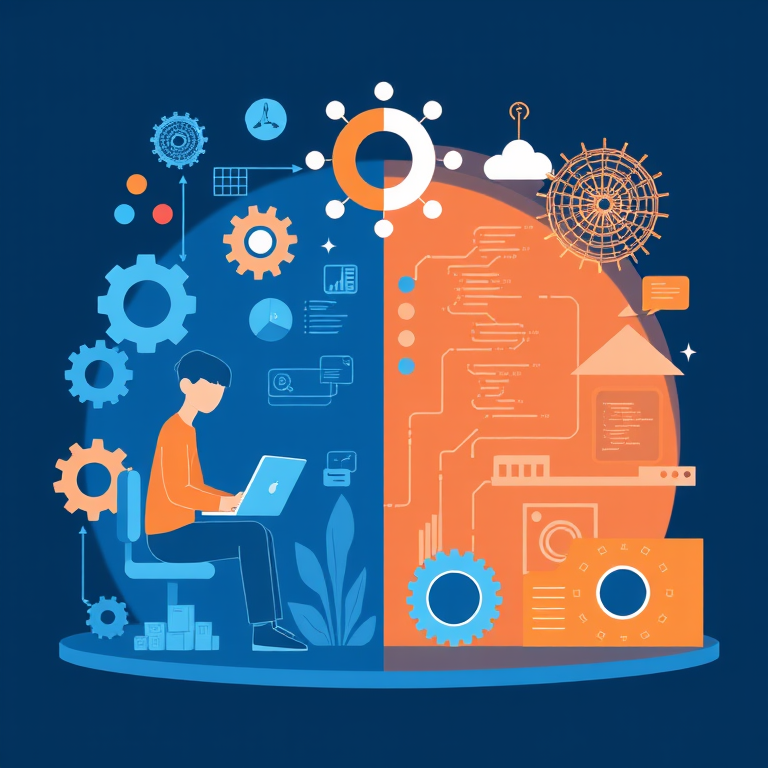
The Chaotic Era of AI Development: Digital Transformation Opportunities for Traditional Industries
In the pre-AI era, there were certain technical tasks that even the most outstanding engineers had to spend roughly the same amount of time (or just slightly faster) as average engineers to complete. These tasks often involved a lot of repetitive work, format conversions, or processes that required following specific procedures but had simple logic.
But now it's different. As long as you have clear logic and rich experience, using AI tools as obedient mid-level engineers to assist, many strange processes in traditional industries can be developed at minimal cost. This not only changes development efficiency but also opens up new possibilities for digitalization in traditional industries.
The Technical Development Dilemma of the Traditional Era
Before the widespread adoption of AI tools, technical development had a clear "efficiency ceiling":
- Repetitive work couldn't be accelerated: Whether writing CRUD APIs, formatting data, or handling file conversions, even the best engineers needed to spend similar time as average engineers to complete these "mechanical" tasks.
- Learning curve limitations: Each new project required understanding specific frameworks, toolchains, or business logic, and this learning process couldn't be completely skipped by "experience."
- Time-consuming detail handling: Handling edge cases, error handling, format validation, and other detailed work, even with simple logic, required completing item by item.
Although these tasks weren't technically difficult, they often became project bottlenecks due to the large time investment required. For traditional industries, these "simple but time-consuming" technical needs were the main obstacles to digital transformation.
The Development Efficiency Revolution in the AI Era
The emergence of AI tools has completely changed this situation. When you have clear logical thinking and rich development experience, AI can become an "obedient mid-level engineer" to help complete a large amount of repetitive work:
1. Code Generation and Refactoring
AI can quickly generate code that meets specifications, from simple CRUD operations to complex business logic implementations. As long as you can clearly describe requirements, AI can produce usable code frameworks in seconds, greatly shortening development time.
2. Format Conversion and Data Processing
Common needs in traditional industries such as data format conversion, report generation, and file processing can now be quickly completed through AI. You don't need to deeply understand the details of each format; you just need to describe the input and output formats, and AI can generate corresponding conversion logic.
3. Documentation and Configuration Generation
Necessary but tedious work like API documentation, configuration files, and database migration scripts can now be handled by AI. This allows developers to focus on core business logic rather than being burdened by these auxiliary tasks.
4. Test and Verification Code
AI can assist in generating unit tests, integration tests, and even end-to-end test code. Although test logic requires human review, the speed of code framework generation has greatly improved.
Digital Transformation Opportunities for Traditional Industries
For traditional industries, the widespread adoption of AI tools has brought unprecedented digital transformation opportunities:
Lowering Technical Barriers
In the past, traditional industries needed to hire professional technical teams or outsource to software companies for digitalization. Now, as long as there are employees with clear logic and deep business understanding within the company, combined with AI tools, they can develop systems that meet needs at minimal cost.
Rapid Iteration and Experimentation
Business processes in traditional industries often have their particularities, and standardized software solutions may not fully meet needs. With AI tools, enterprises can quickly develop customized solutions and rapidly adjust based on actual usage, without waiting for external development team schedules.
Handling "Strange" Business Processes
Every traditional industry has its unique business processes. These processes may seem "strange" or not conform to standard practices, but they are the core of how that industry operates. AI tools make digitalization of these special processes feasible without needing to change business logic to adapt to standard software.
Real-World Case: The Excel Data Conversion Dilemma and Breakthrough
Take a typical example: traditional industries' over-reliance on "Excel." Everything gets organized into Excel, making it impossible to directly import into standard inventory management systems, forcing them to pay high costs for customization.
Indeed, whenever you receive an Excel file that looks neat but is actually full of exceptions, it's a headache. Clarifying all the exceptions in that Excel file is a lengthy process. Because when you've painstakingly written a conversion logic and see the current Excel converting perfectly, you might be thrown back into the abyss by exceptions in another table from a "different month." What's worse, the client can't even explain clearly—they don't know what to tell you, after all, it's a traditional industry.
The Dilemma of Traditional Approaches
In the pre-AI era, developers working on Excel data conversion projects faced challenges including:
- Endless exceptions: Each month's table might have different formats, column orders, or special markers, requiring individual handling.
- High communication costs: Clients often can't clearly explain all exceptions, requiring developers to repeatedly test, discover issues, and ask clients, creating a time-consuming cycle.
- Difficult verification: Even after writing conversion logic, significant time is needed to verify that each exception is correctly handled.
- Unreliable time estimates: Building a system that works with real "legacy" data from order, income, and expense tables, you could only estimate in months.
The AI Era Breakthrough
But now, the situation is completely different:
- After clarifying logic, AI does the implementation: You only need to clarify the logic and exceptions; AI generates the specific conversion code, greatly shortening implementation time.
- Minimal cost verification: You can verify AI output at minimal cost. You can even use IDEs like Cursor to automatically create logs at key points during generation, making it easy to see how far off AI might be.
- Rapid iteration: Layout changes, 3 minutes; adding explanatory text, 1 minute. These are tasks that even the most skilled senior engineers had to spend considerable time on, now they can be completed quickly.
- Dramatically shortened time estimates: Building a system that works with real "legacy" data from order, income, and expense tables can now be estimated in days, not months.
Concrete Efficiency Improvement Data
The following is a time comparison between traditional approaches and AI-assisted development (based on estimates from actual project experience):
| Task | Traditional Time | AI Era Time | Efficiency Gain |
|---|---|---|---|
| Multi-format Excel cleaning | 2–4 weeks | 1–3 days | 10–20x |
| New format exception adjustments | 1–2 days | 5–10 minutes | 50–100x |
| Layout and format adjustments | 2–4 hours | 3–5 minutes | 30–50x |
| Explanatory text and comments | 30–60 minutes | 1–2 minutes | 30–50x |
| Complete system development (orders/income/expenses) | 1–3 months | 3–7 days | 10–30x |
These figures clearly demonstrate the efficiency revolution brought by AI tools. Work that previously required weeks or even months can now be completed in days, without compromising quality.
AI Excel Cleaning Workflow
The following is the standard workflow for using AI tools to process Excel data cleaning:
- Receive client Excel: Receive the original Excel file from the client
- Use AI to list exceptions: Have AI analyze the Excel structure, automatically identify and list all format exceptions, field differences, special markers, etc.
- Senior Engineer confirms logic: Senior engineers review the exceptions identified by AI, confirm business logic and conversion rules
- AI generates cleaning script: Based on confirmed logic, AI generates a complete data cleaning script
- Validate with 3 months of data: Use actual data from multiple months for validation to ensure the script handles various exceptions
- Adjust edge cases: Quickly adjust the script for edge cases discovered during validation
- Deploy: After validation passes, officially deploy for use
The key to this workflow is: AI handles repetitive code generation and preliminary analysis, while senior engineers are responsible for logic confirmation and quality assurance. This collaborative model ensures both efficiency and quality.
This case clearly demonstrates how AI tools change the cost structure of digitalization in traditional industries. Data conversion work that previously required massive time and resources can now be completed at minimal cost while maintaining high quality.
Cognitive Gaps and the Chaotic Era
However, we are in a "chaotic era." Although everyone knows AI can help with many things, there's inconsistent understanding about how detailed this help can be:
Cognitive Differences Among Technical Personnel
- Active Adopters: Have deeply integrated AI tools into their workflows, greatly improving development efficiency.
- Cautious Observers: Still questioning whether AI is helping or hindering, concerned about code quality and security.
- Non-Triers: Lack understanding of AI tool capabilities and limitations, don't know how to use them effectively.
Cognitive Gaps Among Non-Technical Personnel
For companies without technical personnel, the situation is even more severe:
- Completely unaware that times have changed: Still stuck in the old mindset that "digitalization requires massive technical resources."
- Don't know what AI can do: Understanding of AI capabilities may be overly optimistic or overly conservative.
- Lack courage to try: Worried about the cost of investing in AI tools or training, without knowing the potential returns.
Market Chaos
These cognitive gaps have led to market chaos:
- Over-marketing: Some vendors overstate AI capabilities, creating unrealistic expectations.
- Misunderstanding of technical barriers: Some enterprises still think AI tools require deep technical backgrounds to use.
- Investment decision difficulties: With information asymmetry, enterprises struggle to make correct digitalization investment decisions.
How to Effectively Use AI Tools
To effectively use AI tools in this chaotic era, you need to master several key principles:
1. Clear Logic is a Prerequisite
AI tools aren't magic; they need clear instructions to produce useful results. If you can't clearly describe your needs, AI can't help much. Therefore, logical thinking ability is still the foundation for using AI tools.
2. Rich Experience Enables Judgment
AI-generated code or content needs someone to judge its correctness and applicability. This requires rich development experience and domain knowledge. Therefore, AI tools are amplifiers for the experienced, not replacements for beginners.
3. Small Steps, Rapid Verification
Don't let AI generate overly complex systems at once. Instead, adopt a small-step iteration approach, generating a small part of functionality each time, quickly verifying its correctness, then continuing to the next step. This avoids accumulating errors and maintains project control.
4. Establish Verification Mechanisms
For AI-generated code, automated verification mechanisms should be established:
- Automated testing: Ensure functionality meets expectations
- Code review: Check logical correctness and security
- Real-world testing: Verify system behavior in real environments
5. Continuous Learning and Adjustment
AI tools and technologies are rapidly developing, requiring continuous learning of new usage methods and best practices. At the same time, adjust workflows and tool choices based on actual usage experience.
The Risk Boundaries of AI Capabilities
While AI tools bring tremendous efficiency improvements, we must also clearly understand AI's limitations to use it more safely and effectively:
1. AI is Prone to Hallucination
AI may generate code or logic that seems reasonable but is actually incorrect. It might "fabricate" non-existent APIs, incorrect function names, or solutions that seem logically correct but don't actually meet requirements. Therefore, all AI-generated code must undergo human review and testing—it cannot be trusted directly.
2. Edge Cases Still Require Senior Engineers
While AI can handle most common scenarios, when encountering complex edge cases, special business logic, or problems requiring deep domain knowledge, it still needs senior engineers' judgment and handling. AI tools are amplifiers, but cannot completely replace senior engineers' professional judgment.
3. Security and Privacy Still Need Oversight
When using AI tools, you must be aware of:
- Sensitive data handling: Do not directly input sensitive data such as customer information or financial data into public AI services
- Code security review: AI-generated code may contain security vulnerabilities and must undergo professional security review
- Compliance considerations: Ensure the way AI tools are used complies with relevant regulations and company policies
4. Risks of Over-Dependence
Over-reliance on AI tools may lead to:
- Skill degradation: Developers may lose the ability to write code manually and think deeply
- Insufficient understanding: Understanding of systems may remain superficial, unable to handle complex problems
- Limited innovation: Over-reliance on AI's standard solutions may limit innovative thinking
Therefore, AI tools should serve as auxiliary tools, not complete replacements for developers' thinking and learning.
5. Balancing Cost and Benefit
While AI tools significantly improve efficiency, you should also note:
- AI service costs: Using AI services (such as API calls) may generate ongoing costs
- Verification costs: Although verification costs are reduced, time still needs to be invested in review and testing
- Learning costs: Teams need to learn how to effectively use AI tools, which also requires time investment
The key is finding the optimal balance between cost and benefit, allowing AI tools to maximize value in appropriate scenarios.
Recommendations for Traditional Industries
For traditional industries to seize this digital transformation opportunity, the following strategies are recommended:
- Cultivate internal technical capabilities: You don't need to become top engineers, but you need people who can understand business logic and use AI tools to transform it into systems.
- Start with small projects: Don't try large digitalization projects from the start; begin with small, specific business processes to accumulate experience and confidence.
- Establish collaboration mechanisms: Internal personnel handle business logic and requirement definition, AI tools handle code generation, and seek external technical consultants when necessary.
- Maintain an open attitude: Don't give up trying because "we're not a tech company"; AI tools have significantly lowered technical barriers.
Conclusion
We are at a critical moment of technological transformation. AI tools have not only changed development efficiency but also opened up new possibilities for digitalization in traditional industries. However, this era is also chaotic, with cognitive gaps and information asymmetry causing many enterprises to miss transformation opportunities.
The key is: People with clear logic and rich experience, combined with AI tools, can complete work that previously required massive technical resources at minimal cost. For traditional industries, this is an unprecedented digital transformation opportunity.
But remember, AI tools are amplifiers, not replacements. They need clear logic and rich experience to maximize value. In this chaotic era, maintaining learning, continuous experimentation, and establishing verification mechanisms will help you find your place in the AI era.
Postscript: The Creation Process of This Article
This article itself is a real-world case study of AI-assisted development. The entire article was completed through conversational collaboration with an AI assistant (Cursor): from the initial draft, gradually refining the content, adding real-world cases, supplementing efficiency comparison data, to finally adding risk boundary analysis—the entire process was completed iteratively through conversation.
On the left is the AI assistant providing suggestions and modifications in the IDE, and on the right is the blog article being previewed in real-time. This "chat while creating" approach is exactly the embodiment of the AI-assisted development model described in this article: humans with clear logic provide direction and judgment, while AI handles specific content generation and formatting, ultimately completing high-quality content output at minimal cost.
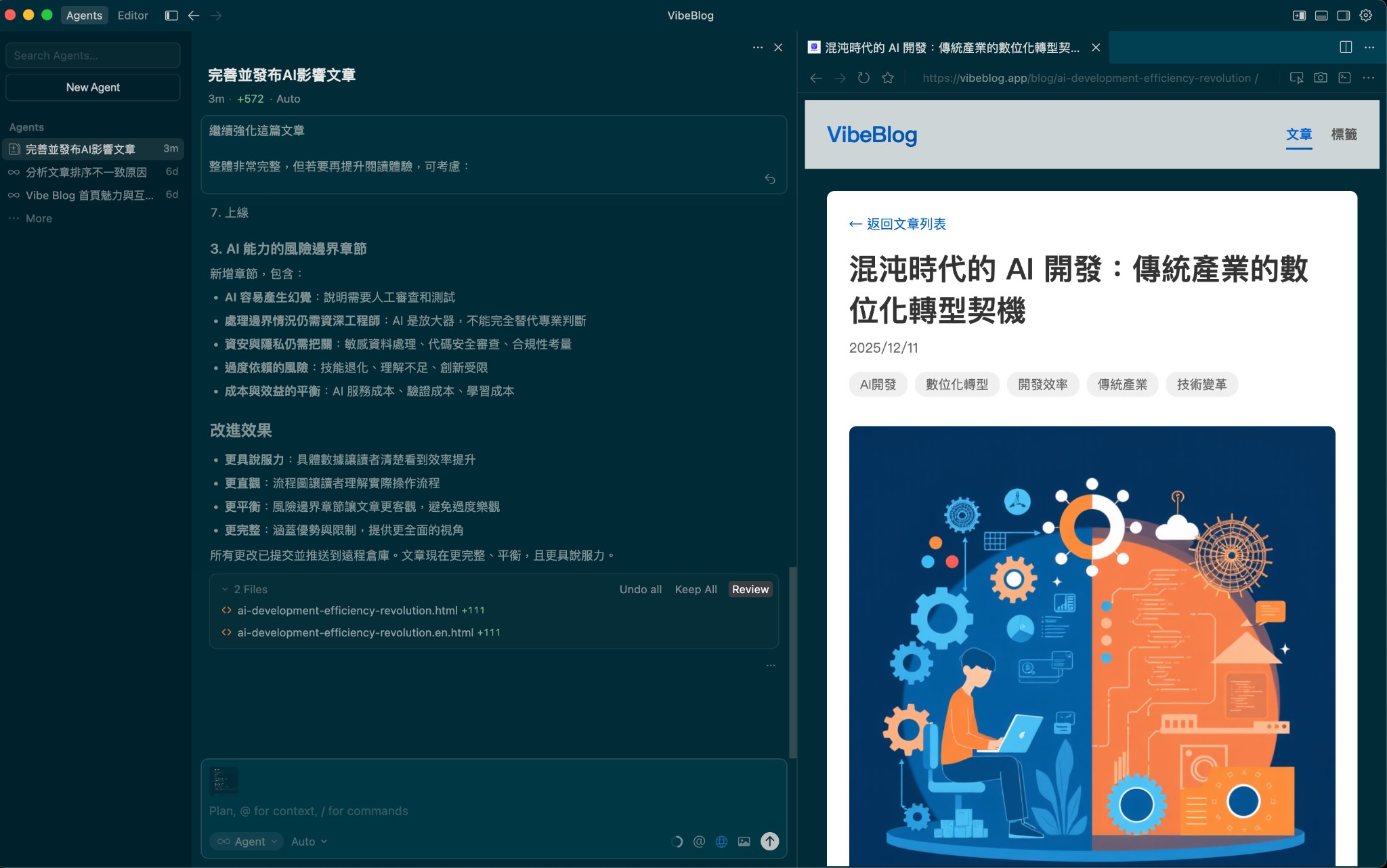
This not only proves the practicality of AI tools in the content creation field but also demonstrates the core argument: "People with clear logic and rich experience, combined with AI tools, can complete work that previously required massive time at minimal cost."
This article explores how AI is changing development efficiency and the opportunities and challenges traditional industries face in this era. We hope it helps enterprises and individuals thinking about digital transformation.